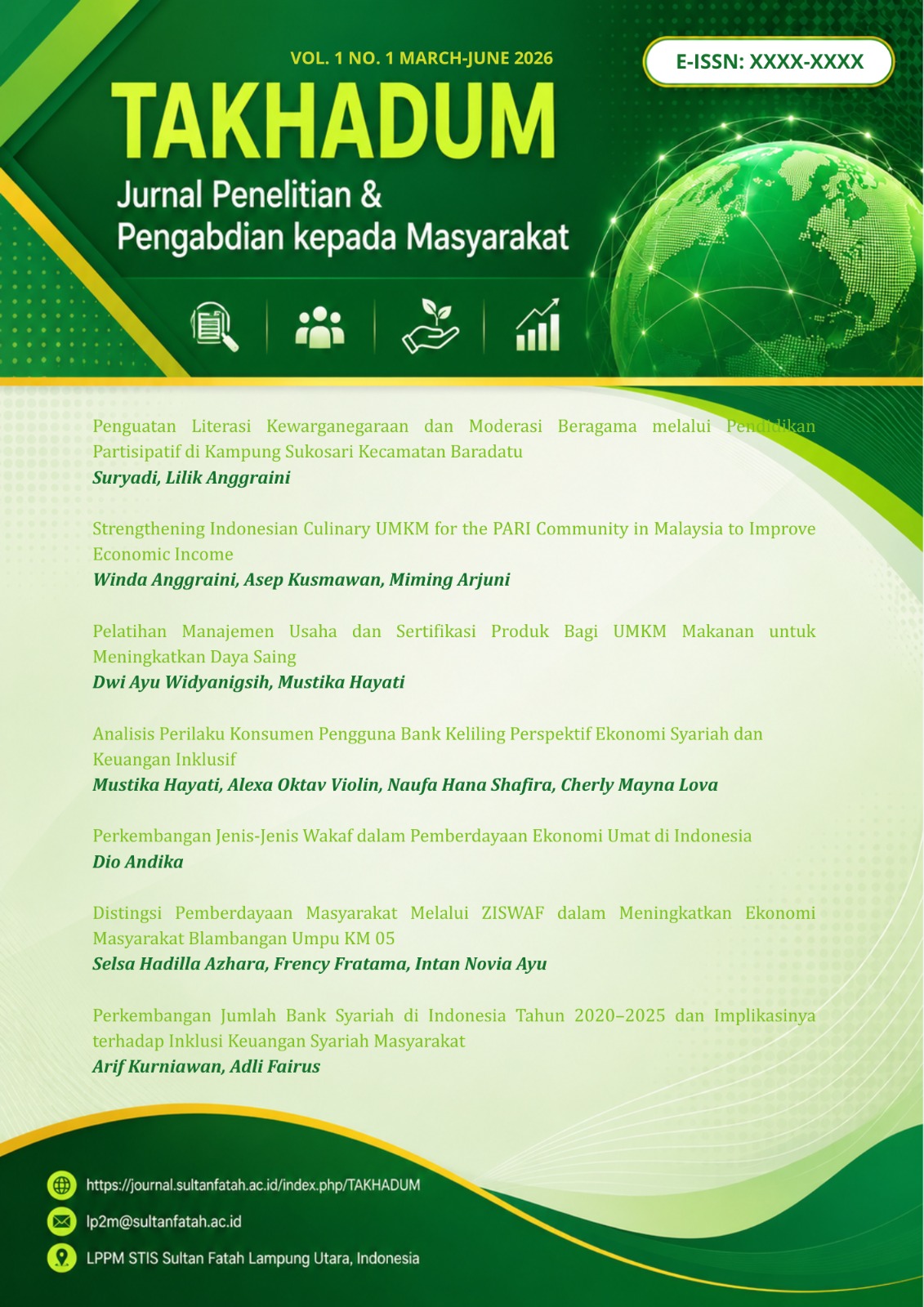
Strengthening Indonesian Culinary UMKM for the PARI Community in Malaysia to Improve Economic Income
Keywords:
Culinary UMKM, Community Service, Digital Marketing, Indonesian Diaspora, Malaysia, Economic EmpowermentAbstract
This community service program aims to strengthen Indonesian culinary UMKM within the PARI community in Malaysia through digital marketing training, branding enhancement, business management assistance, and entrepreneurial mentoring. The program employed a participatory approach involving observations, interviews, training sessions, direct mentoring, and program evaluation involving Indonesian diaspora culinary entrepreneurs in Malaysia. The results demonstrate that participants experienced significant improvements in digital literacy, product branding, financial management, and entrepreneurial capacity. Participants began utilizing digital platforms such as Instagram, TikTok, Facebook, and WhatsApp Business to expand market reach and improve customer engagement. In addition, improvements in packaging design, branding strategies, and financial recordkeeping contributed to increasing product competitiveness and business sustainability. The program also generated positive economic impacts through increased sales and customer numbers among participants. This study confirms that integrative and participatory empowerment models are effective strategies for strengthening diaspora-based culinary UMKM and improving the economic welfare of Indonesian migrant communities in Malaysia.
References
Azis, M., Rahman, F., & Putri, D. A. (2026). Strengthening digital literacy among Indonesian diaspora UMKM in Kuala Lumpur through community empowerment programs. Journal of Community Development and Empowerment, 8(1), 45–58.
Chaffey, D., & Ellis-Chadwick, F. (2019). Digital Marketing: Strategy, Implementation and Practice (7th ed.). Pearson Education Limited.
Dewi, R., Prasetyo, A., & Kurniawan, H. (2026). Strengthening managerial capacity and competitiveness of culinary UMKM through community-based training programs. International Journal of Entrepreneurship and Small Business, 39(2), 211–225.
Hisrich, R. D., & Peters, M. P. (2020). Entrepreneurship (11th ed.). McGraw-Hill Education.
Kotler, P., & Keller, K. L. (2016). Marketing Management (15th ed.). Pearson Education.
Novitasari, L. (2022). The contribution of UMKM to economic growth and community welfare in Indonesia. Journal of Indonesian Economic Studies, 14(2), 101–115.
OECD. (2021). The Digital Transformation of SMEs. Organisation for Economic Co-operation and Development Publishing.
Porter, M. E. (1990). The Competitive Advantage of Nations. Free Press.
Schumpeter, J. A. (1934). The Theory of Economic Development. Harvard University Press.
Susanti, R., Abdullah, M., & Sari, N. (2024). The role of digital marketing in expanding market access for small enterprises in Southeast Asia. Asian Journal of Business and Management, 12(3), 88–99.
Tuten, T. L., & Solomon,M. R. (2018). Social Media Marketing (3rd ed.). Sage Publications.
UNCTAD. (2021). Digital Economy Report 2021: Cross-border Data Flows and Development. United Nations Conference on Trade and Development.
Utami, S., Hidayat, R., & Nugroho, A. (2025). Community mentoring and economic sustainability among Indonesian migrant entrepreneurs in Malaysia. International Journal of Migration and Social Development, 6(1), 67–81.
Wilson, J. A. J., & Liu, J. (2011). The challenges of Islamic branding: Navigating emotions and halal. Journal of Islamic Marketing, 2(1), 28–42.
World Bank. (2022). Small and Medium Enterprises (SMEs) Finance: Improving SMEs’ Access to Finance and Finding Innovative Solutions to Unlock Sources of Capital. World Bank Group.
Downloads
Published
Issue
Section
License
Copyright (c) 2026 Winda Anggraini, Asep Kusmawan, Miming Arjuni (Author)

This work is licensed under a Creative Commons Attribution-ShareAlike 4.0 International License.